
3rd Quarter 2026 Outlook
September 11, 2026
CHAD RICE, MS, CFA® I SEPT 2026
Executive Summary
- Markets entered the third quarter with stronger momentum than expected, supported by resilient economic data, strong Q2 equity returns, and continued AI-related capital investment, but persistent inflation, fiscal deficits, and geopolitical risk keep the rate outlook unsettled.
- U.S. corporate pension funded status improved meaningfully during Q2, with strong equity returns and higher early-Q3 discount rates reinforcing an already favorable position for many defined benefit plan sponsors.
- For ALIS portfolios, the practical message is to protect funded-status gains, maintain liability alignment, emphasize quality within fixed income, and avoid adding uncompensated spread or duration risk.
State of the Markets
The third quarter of 2026 opened with strong market momentum following a sharp Q2 rebound. Resilient economic growth, solid corporate earnings, and continued investment in artificial intelligence infrastructure supported risk assets, with the S&P 500 rising approximately 15% and the NASDAQ gaining more than 20%. Inflation, federal deficits, and geopolitical tensions remained clear risks, but investors focused primarily on improving fundamentals and continued economic expansion.
Fixed income markets faced modestly higher rates as inflation remained above the Federal Reserve’s target and market expectations shifted away from rate cuts and toward potential tightening. The 10-year Treasury yield rose from roughly 4.3% to 4.5%, while the 30-year Treasury yield rose to nearly 5%. Despite higher yields, most high-quality bond sectors produced modest positive returns, supported by stable credit conditions and demand for income-oriented assets.
Key Economic Influences and Events from Q2 2026
Geopolitical Uncertainty and Energy Prices: The U.S.-Iran conflict created a volatile backdrop during the quarter, with oil prices rising as high as $99 per barrel in May before ending the quarter near $70 per barrel. The spike in energy prices weighed on consumer sentiment, which fell to record-low levels and had not materially recovered by quarter-end. While survey data weakened, most hard economic data remained positive.
Inflation and Real Wages: Inflation remained a key concern for markets and policymakers. Much of the recent inflation pressure was tied to energy and core services. There is still hope that the recent energy shock proves transitory and remains tied to the conflict with Iran rather than becoming a broader inflationary trend. The inflation impulse pushed real wage growth into negative territory, creating a purchasing-power headwind for workers.
Labor Market Resilience: The labor market remained stable. In June, the unemployment rate moved lower to 4.2%, and recent JOLTS data showed job availability improving from below one job per job seeker to 1.04 jobs per unemployed person. Services continued to show strength, while manufacturing turned positive after a prolonged period of contraction. Manufacturing activity appears to have benefited from the AI buildout, reshoring efforts, and OBBBA depreciation incentives.
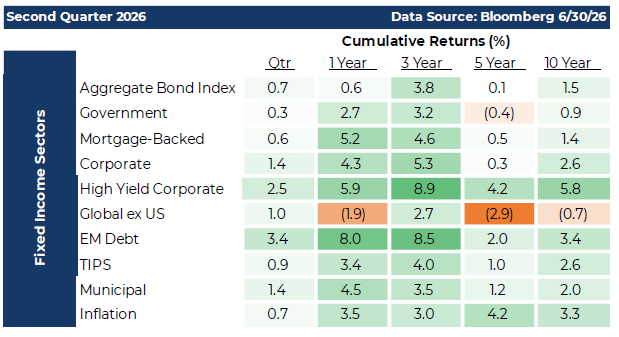
Rates and Market Performance: Treasury yields rose during the quarter, with the 10-year Treasury yield increasing about 20 basis points as an example. The 30-year Treasury yield moved near 5%, a level reached only briefly during a handful of periods over the last two decades. Taxable bond indexes generated year-to-date returns of roughly 1%.
Fiscal Deficits and Term Premiums: Persistent deficits, ongoing debt issuance, and continued inflationary pressures likely increased the term premium embedded in the Treasury curve. Investors continue to demand additional yield compensation as the government finances substantial debt obligations.
Pension Market Update
As we move through the third quarter of 2026, U.S. corporate defined benefit plans remain in a strong financial position following a significant improvement in funded status during Q2. Strong equity returns were the primary driver, while modest changes in discount rates provided only a small offset. The Milliman 100 funded ratio increased from 106.3% on March 31 to 109.5% on June 30, and Wilshire estimated a 5.5 percentage-point quarterly improvement to 108.7%. Early Q3 data extended the trend, as higher long-term interest rates reduced liability values and pushed several pension monitors to new 2026 highs.
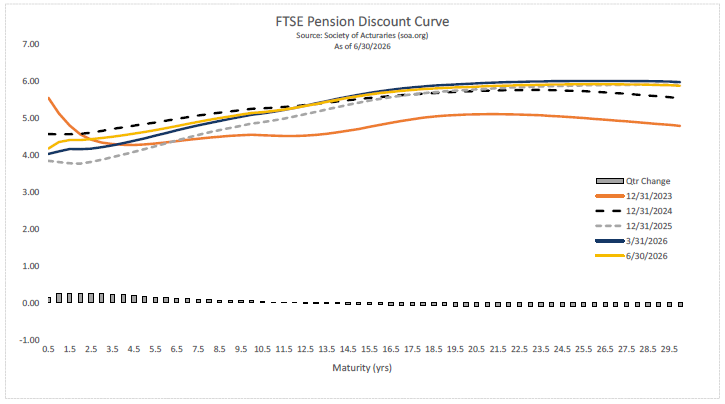
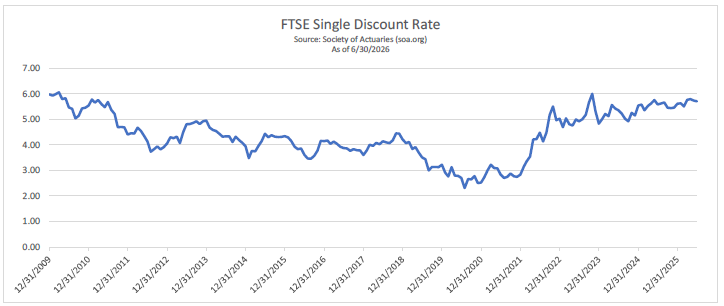
Treasury Yields and Discount Rates: The Treasury curve flattened and shifted higher during Q2 as inflation concerns and expectations for Federal Reserve tightening lifted shorter-term yields. The 2-year Treasury yield rose 38 basis points, while the 30-year yield increased 7 basis points. Pension discount-rate measures varied by methodology, but the Milliman rate declined 4 basis points during Q2 to 5.61%. In July, corporate bond yields rose approximately 35 basis points, reducing modeled pension liabilities by roughly 2% to 4% and producing additional funded-status gains despite weaker bond and equity returns.
Corporate Credit Spreads: Investment-grade credit spreads tightened during Q2, supporting returns but leaving less compensation for credit risk. Aggregate U.S. corporate spreads narrowed 15 basis points, with intermediate spreads tightening 16 basis points and long spreads tightening 11 basis points. Rising stars totaled $45.3 billion in the first half of 2026, compared with $30.1 billion of fallen angels and $11.1 billion of defaults. For liability- hedging portfolios, tight spreads and heavy new issuance reinforce the importance of quality, issuer selection, and disciplined diversification.
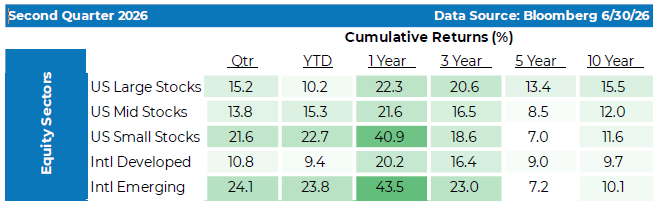
Domestic Equity Markets: Equity markets delivered a strong quarter despite geopolitical and energy-price volatility. The S&P 500 returned 15.2% in Q2 and 10.2% year to date through June, while the MSCI Emerging Markets Index returned 24.1% for the quarter and 23.9% year to date. These gains materially strengthened pension assets and were the principal contributor to the improvement in funded status. July was less supportive for risk assets but rising discount rates more than offset weaker asset performance for many plans.
Funded Status and ALIS Implications: Industry measures clustered near historically strong levels at quarter-end. L&G estimated a typical plan funded ratio of approximately 110%, Milliman reported 109.5%, Wilshire reported 108.7%, and WTW estimated 106.6% for its Fortune 1000 universe. The practical implication is clear: sponsors should confirm whether recent gains have triggered glide-path actions, evaluate interest-rate and credit hedge alignment, rebalance promptly where policy thresholds have been crossed, and protect surplus rather than allow improved funded status to become an unintended increase in risk.
Pension Risk Transfer (PRT) Market: Higher funded ratios continue to improve plan sponsors’ strategic flexibility, but transaction activity began in 2026 more slowly. First-quarter pension risk transfer sales totaled $3.8 billion, down 47% from the prior year, with buyouts driving the decline while buy-in activity remained comparatively strong. Sponsors considering a transaction should maintain plan data readiness, monitor insurer pricing and capacity, and evaluate pension risk transfer alongside partial de-risking and liability-edging alternatives rather than treating it as the only end-state option.
Economic Outlook
The economic backdrop remains constructive but less forgiving. Growth is supported by fiscal stimulus, tariff refunds, AI-related productivity gains, AI capital expenditures, a stable labor market, and the wealth effect from higher equity markets. At the same time, elevated energy prices, negative real wage pressure, and persistent inflation continue to challenge consumers and policymakers.
The Federal Reserve outlook has shifted materially. Earlier expectations for 2026 rate cuts have given way to a more restrictive policy discussion as inflation remains elevated and energy-price volatility complicates the path back to target. The more defensible base case is not a quick easing cycle, but a period of policy restraint in which the Fed uses balance-sheet reduction and data-dependent guidance before considering additional rate hikes.
Artificial intelligence remains a major economic and market driver. AI-related spending continues to support capital investment, productivity expectations, and corporate earnings momentum. The risk is that the same investment cycle may also increase corporate borrowing needs, concentrate issuance in technology-related sectors, and pressure credit spreads if supply begins to exceed investor demand.
Our base case is a range-bound but volatile rate environment. We expect the 10-year Treasury yield to remain within a 4.0% to 4.80% range during 2026, with long-term yields influenced by inflation data, Treasury issuance, term premiums, and the Fed’s balance-sheet policy. For plan sponsors, the implication is straightforward: funded-status gains are valuable, but they should not be treated as permanent unless the investment strategy locks in progress through disciplined hedge alignment, rebalancing and glide-path maintenance.
Investment Strategy
For ALIS portfolios, the current environment calls for discipline rather than a major directional shift. Economic growth remains resilient, unemployment is low, corporate earnings are strong, AI investment continues to support activity, and fiscal stimulus remains a tailwind. Those positives are offset by persistent inflation, elevated deficits, tight credit spreads, geopolitical uncertainty, and the risk that AI-related borrowing creates greater dispersion across corporate issuers.
The fixed income opportunity remains attractive, but selectivity matters. Higher real rates support maintaining exposure to high-quality bonds, particularly in liability-aware portfolios. However, tight credit spreads and heavy government and corporate issuance reduce the margin for error. Portfolio construction should emphasize duration discipline, reinvestment planning, issuer quality, and spread compensation rather than reaching for incremental yield without adequate risk reward.
Plan sponsors should use the current funded-status strength to reduce unrewarded risk. Strong funded ratios create optionality, but they also raise the cost of inaction if market gains are allowed to drift into higher surplus volatility. Sponsors should confirm whether glide-path triggers have been reached, rebalance promptly when thresholds are crossed, and verify that interest-rate and credit hedge ratios remain aligned with liability characteristics.
The practical conclusion is clear: remain selective, liability-aware, and ready to act. A rangebound rate environment does not eliminate opportunity, but it increases the importance of matching portfolio structure to plan objectives. Given persistent deficits, elevated long-term Treasury yields, tight spreads, and the Fed’s likely shift toward balance-sheet reduction, high-quality fixed income should remain the foundation of ALIS portfolio stability while flexibility is preserved for tactical adjustments.
Investment advisory services are offered through Advanced Capital Group ("ACG"), an SEC registered investment adviser. The information provided herein is intended to be informative in nature and not intended to be advice relative to any specific investment or portfolio offered through ACG. The views expressed in this commentary reflect the opinion of the presenter based on data available as of the date this was written and is subject to change without notice. Information used is from sources deemed to be reliable. ACG is not liable for errors from these third sources. This commentary is not a complete analysis of any sector, industry, or security. The information provided in this commentary is not a solicitation for the investment management services of ACG and is for educational purposes only. References to specific securities are solely for illustration and education, relative to the market and related commentary. Individual investors should consult with their financial advisor before implementing changes in their portfolio based on opinions expressed.
Sources: L&G Pension Solutions Monitor, June 2026; Milliman 100 Pension Funding Index, June 2026; Wilshire U.S.
Corporate Pension Plans Funding Status, June 2026; WTW Pension Finance Watch, June 2026; Insight US PensionWatch, Q2 2026; October Three Pension Finance Update, July 2026; NEPC Pension Monitor, July 2026.